Welcome to the Gurteen Knowledge Log. This log is a
weblog
in which I blog items of interest that I have found on the web, experiences or insights that I think you will find useful mainly but not strictly limited to the area of knowledge management and learning. Like the rest of my site - it an eclectic mix.
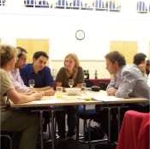
Amazingly Twitter brought us one extra participant Colleen Carmean who blogged a little on the Cafe; said some nice things about me (blush) and had some interesting comments about the format that I had not quite seen before given my closeness. Here are two quotes from her:
David uses a specific, distributed, what I would call "emergence" format where 'the whole is greater than the sum of the parts' for encouraging knowledge transfer amongst participants. No leaders, no report outs, no death by PowerPoint. Everyone matters, every voice counts.
The closing moments of a Knowledge Cafe reminded me of a Quaker meeting. You don't speak unless you're compelled to share an important thought, realization, or theme that emerged from your multiple small group discussions. Some participants violate the framework and just need to be heard, but like the Quakers, everyone listens respectfully and reflects on the thought without the need for comment or debate.
When I read this, a light bulb flashed. When working at home, I am a documentary junkie - the UK History Channel and other documentary and news channels are pretty much all I watch. But time and time again I get a angry when I see the program makers turn the problems facing the world into entertainment. Their objective is not even to educate but to entertain. Often I switch off and throw the remote at a distant chair (a soft one I might add as I never get that angry)!
What I have long wanted more media companies to do - is to start taking the problems seriously and move from saying "here are the problems - isn't it tragic; isn't it crazy" to "here are the problems and here is what you can do to help solve them. And this is what we are setting up to help support you".
But the participatory web is moving us in this direction. In 50 years time I think we will look back at old news clips and documentaries of today in a similar way we look back at the propaganda newsreels of the Second World War and wonder why so many people at the time did not see things for what they were.
Whenever I meet new people with whom I would like to work I often say lets find a small project on which we can work together so we can build mutual trust. The process is simple.
We work on something small and build trust.
Having built trust we work together more and the trust grows.
Its an iterative process: work together; build trust; work together build trust ... but this is key - it always starts by working together.
If at any time either of us lets the other down badly or abuses the relationship then the trust is pretty much destroyed and its unlikely that we will ever work together again.
The trust question is a classic confusion of symptoms with cause, just as creativity is a symptom of innovation not its cause, so trust is the symptom of interaction over time. If that interaction is not testing, then the trust is fragile. If the trust is simply the result of few contextual exercises (throwing yourself backwards off a brick wall is the classic) then it is temporary. Focus on the process, rather than trying to preset emergent outcomes and you get a more sustainable solution.
Would you like to know almost everything I or friend has been up to of late then take a look at FriendFeed.
FriendFeed enables you to keep up-to-date on the web pages, photos, videos and music that your friends and family are sharing. It offers a unique way to discover and discuss information among friends.
Sign up for FriendFeed, invite some friends, and get a customized feed made up of the content that your friends shared - from news articles to family photos to interesting links and videos.
FriendFeed automatically imports shared stuff from sites across the web, so if your friend favorites a video on YouTube, you get a link and a thumbnail of the video in your feed.
And if your friend likes a news story on Digg, you get a link in your feed. FriendFeed makes all the sites you already use a little more social.
I have been using it for a month or so now but I'm not yet convinced of its use as it gives me TOO much information. But the good thing about social tools - what does not work for me might work for you and vice-versa.
I recently wrote about Kiva - an amazing microfinace website and then on the human touch - the importance of face to face communication in my Knowledge Cafes and so I was delighted to receive this email from Larry Gardiner that I have included in full:
First an update on your item about Kiva. We asked our family and friends to send Kiva Gift Certificates instead of cards and presents at Christmas after reading about Kiva.org in your newsletter. 15 Kiva certificates have now been redeemed and we receive regular bulletins on our portfolio of micro-finance investments from Cambodia, Vietnam, Peru, Mexico, Nigeria and Kenya. Each of our investments is thriving and the most rewarding part of watching their progress is the sense of solidarity which I think is also a feature of the human touch you were talking about.
We have started convening Parent Cafe's too. The purpose here is to facilitate knowledge sharing around the development of parent and peer advocacy for families with disabled children (http://www.parentadvocatestogether.org.uk). We also have used the time-discipline you talked about so that each person has the same amount of air-time.
We have not intentionally set out to create a therapeutic knowledge cafe, or I suppose what would be a support group session, but to simply borrow from a framework of ideas (which we do use to promote emotional support and 'discharge' in other parent support groups convened for that specific purpose). I suppose that when everyone knows that they will get their own space, their own air time and their own opportunity to think and listen out loud, it makes it easier for us to relax and to listen and to process on what what each speaker is saying.
While we didn't deliberately set out to do this awarely; solidarity and mutual self-help and assistance are what we seem to be eliciting in each of our own knowledge cafe ventures. It is very satisfying and rather beautiful both to see and to experience. It is rather that the experience of using co-counselling tools in that setting that has enabled us to cross-pollinate some of the ideas. We have noticed that they have been useful in promoting an emotional safety allowing people to enjoy and even to revel in the human touch you talked about.
You are absolutely right to claim that it is this human touch which is the key distinguishing feature of the knowledge cafe phenomenon. Essentially, we now set out purposefully to cultivate, nurture and promote every opportunity for creating that human touch you have described in every knowledge cafe where we participate. From experience we can state that 'the human touch is also the magic touch!' As far as culture change is concerned; this is simply a smarter way to work.
Much of Dubai has this Disney feel to it at times but Luke is blogging his stay in Dubai and his blog is a great way to get to see a lot more of Dubai and the region that is far from Disney-like!
The idea of thoughts making love - what a lovely metaphor!! Two thoughts coming together, intermingling their DNA to create new baby thoughts with a unique life of their own. I am getting carried away now!
I recently spent the whole of January in SE Asia; giving talks and running knowledge cafes in Singapore, Kuala Lumpur and Bangkok. As always I learnt as much as a I taught at these events.
Most of us understand what Web 2.0 is all about as we move from a read-only web to a read-write or participatory web.
And we are starting to come to grips with so called Enterprise 2.0 where the concept and technologies and social tools of Web 2.0 are moving from the open web into organizations.
It is still early days and there are many issues to be grappled with as we try to balance the structure and stability of the old world with the more fluid and complex nature of the new.
But the "2.0 meme" is starting to affect everything. In a talk in Kuala Lumpur I was asked how you implement Enterprise 2.0 and I was talking about some of the barriers when someone spoke up and said "We will never have Enterprise 2.0 until we have Managers 2.0!” In other words it was managers and their out-dated mind sets that was a major barrier to change,
And a few days later while giving another talk at the National Library in Singapore I found us talking about Libraries 2.0 and Learning 2.0. It then hit me that “2.0” thinking was permeating everything. People were also taking about Business 2.0 and Education 2.0.
So what does this mean in its broadest sense? Well, we are no longer consumers: of goods, services or education - we are all prosumers - we all have the opportunity to create and consume. For the first time we are participants in everything and not the “victims”. Fundamentally it is about "freedom".
We are moving from a world where we were told to do things and where things were structured or planned for us to one where we get to decide what works best for us. We are moving from a mono-culture to a highly diverse ecology.
We are moving from a simple world to a rich, complex, diverse one. One where power is less centralized and more distributed. We are moving from a command and control world to a world where people can do as they please within the boundaries of responsibility.
Another talk I gave in SE Asia was to SAFTI (the Singapore Armed Forces Training Institute) and there I realized that the 2.0 concept could be applied to the military too. In the past warfare was a relatively simple affair; there were rules of engagement and things such as the Geneva convention. It was a male dominated world but now with terrorism, men, women and children are actively involved in the fighting - there are few rules of engagement. Its complex – everyone participates.
The SAFTI talk was the last of 20 talks and Knowledge Cafes over a period of a month and they helped crystallize my thinking. It’s not just about Web 2.0 and Enterprise 2.0 - about tools and technology. Its far more than that. It’s about World 2.0. The “2.0 meme” touches everything.
More than anything we need "Mindset 2.0" or "Thinking 2.0" - new ways of looking at and thinking about the world and seeing the opportunities to work in new innovative ways that these new technologies allow.
Here is a brief comparison of the two worlds. This thinking can be applied in business, in education and learning, to adults and to children and to government and to society. Its not just about technology!
World 1.0
World 2.0
Knowledge sharing and learning is imposed additional work
Knowledge sharing and social learning is a welcome natural part of people's everyday work
Work takes places behind closed doors
Work takes place transparently where everyone can see it
IT Tools are imposed on people
People select the tools that work best for them
People are controlled out of fear they will do wrong
People are given freedom in return for accepting responsibility
Information is centralized, protected and controlled
Information is distributed freely and uncontrolled
Publishing is centrally controlled
Anyone can publish what they want
Context is stripped from information
Context is retained in the form of stories
People think quietly alone
People think out loud together
People tend to write in the third person, in a professional voice
People write in the first person in their own voice
People especially those in authority are closed to new ideas and new ways of working
Everyone is open to new ideas
Information is pushed to people whether they have asked for it or not
People decide the information they need and subscribe to it
The world is seen through a Newtonian cause and effect model
The world is recognized to be complex and that different approaches are needed
“The real paradigm shift in Web 2.0, I believe, is the blurring the line between publication and collaboration. In the old days, people collaborated in private. They talked to their friends and colleagues, wrote letters. Later they sent emails. All the real thinking happened in those private conversations. Eventually, once the key insights had been extracted, refined, and clarified, they published: books, articles, speeches, blast memos, etc.”
“…the really exciting thing that’s happening in Web 2.0 and Enterprise 2.0 is that more and more of those private “pre-publication” interactions are happening in public (or at least semi-public). I think of this as the dawn of the “Work in Progress” culture. We no longer think that something has to be finished before we let strangers into the conversation.”
And then Gerry McKiernan in this post on Science 2.0.
A small but growing number of researchers--and not just the younger ones--have begun to carry out their work via the wide-open blogs, wikis and social networks of Web 2.0. And although their efforts are still too scattered to be called a movement--yet--their experiences to date suggest that this kind of Web-based "Science 2.0" is not only more collegial than the traditional variety, but considerably more productive.
Take a look. How might you work more transparently?
One man who has hugely influenced me is Henry David Thoreau. I love his work and the lasting influence he had on the world. A friend reminded me of him while browsing in a London bookshop and I bought her his book Walden and then later googled for him on YouTube and found this video.
And here one of my favorite quotes On grading the whole surface of the planet that's a little too long to embed here. Its more relevent today after over 100 years than it has ever been - today we really are in danger of grading the whole planet!
Have you discovered SlideShare yet? I post all my public powerpoint presentations to it and there is even a Knowledge Management group on the site with 130 slideshows.
This video Shift Happens Narrated will scare you or to inspire you or maybe a little of both depending on your attitude to life. And oh yes your reaction might also be a function of where you live in the world as it is written for an American audience! Also see this original unnarrated version.
I recently received a request from Xiuli Zhuang at the School of Educational Technology, Beijing Normal University in China to translate my article KM 2.0: KM goes social into Chinese. And of course I agreed.
Well here is the Chinese translation. I hope the Chinese language readers amongst you enjoy it!
But it's not that cultural change needs to precede Enterprise or KM 2.0. They are intertwined. As early adopters start to use social tools and adopt "2.0" thinking they will slowly influence the culture of their organizations and as they do more people will see the benefits and become involved and in turn exert a stronger influence on the culture. And through this iterative process things will change.
The pace will quicken if some proactive initiatives are undertaken - especially to create Managers 2.0 but slowly but surely I believe the culture will change hand in hand with the evolution and adoption of the tools.
Many of you will know of Lawrence Lessig - a professor of law at Stanford Law School and founder and CEO of the Creative Commons and like me will be an admirer of his work.
What you may not know though is he recently announced that he will stop focusing his attention on copyright and related matters, and will instead work on corruption in the political system. He explains why in this video interview.
Listen to the interview - this is a fundamental KM issue - we have the knowledge - we understand the problems but we don't take action or we take the wrong action because the system is corrupt. Lessig thinks the solution lies in Commons-based peer production.
This is a man to watch carefully and to support. I am intrigued as to where this heading. As Lessig says in the interview if we are going to solve problems like global warming then we need to fix the "corruption" first.
Every so often I come across a simple tip that someone has shared on the web that is so useful I am compelled to share it in turn. And one person I have learnt so much from and who has connected me with so many of the best social media tools at an early stage in their evolution is Robin Good. Robin is colorful character and the work he does is fantastic.
So take a look at this little video of him explaining how you can edit a Skype message after you have sent it. And then browse his site a little - for some more fascinating material!
I have been talking recently about KM going social and the concept of KM2.0. Well its not only KM that Web 2.0 tools and technologies are impacting - its learning too. This is really not too surprising as "learning" is one of the main objectives and outcomes of "knowledge sharing" and at times the two concepts are synonymous.
Ray Sims recently blogged on this and quoted from a paper by Mohamed Amine Chatti, Matthias Jarke, and Dirk Frosch-Wilke.
To have a chance of success, LM and KM approaches need to recognize the social aspect of learning and knowledge and as a consequence place a strong emphasis on knowledge networking and community building to leverage, create, sustain and share knowledge in a collaborative way, through participation, dialogue, discussion, observation and imitation.
I have recently updated the Learning category page on my website to include a tentative definition of Learning 2.0 adapted from a blog post by Denise Withers.
Learning 2.0 is an emerging approach to learning that turns away from teaching as something that is “done to learners” - and instead, embraces methods in which learning becomes “an on-going and participatory process of transforming information and experience into knowledge".
Another guy you might like to check who has a lot to say about this is Stephen Downes. And take a look at this blog post from Dina Mehta on Social Learning.
One of the things I love about a conversational cafe is that it is a very flexible format and can be adapted to different purposes. I recently discovered Science Cafes and Cafe Scientifique via an article in Wired Magazine.
Science cafés involve a lively conversation with a scientist about current science topics. They are open to everyone, and take place in casual settings like pubs and coffeehouses.
At a café you can…
learn about the latest issues in science
chat with a scientist in plain language
meet new friends
speak your mind
talk with your mouth full
Cafe Scientifique is a place where, for the price of a cup of coffee or a
glass of wine, anyone can come to explore the latest ideas in science
and technology. Meetings take place in cafes, bars, restaurants and even theatres, but always outside a traditional academic context.
Still, that E2.0 is the new KM didn’t hit me for a while. But when Andy said the ultimate value of E2.0 initiatives consists of greater responsiveness, better “knowledge capture and sharing,” and more effective “collective intelligence,” there wasn’t much doubt. When he talked about the need for a willingness to share and a helpful attitude, I remembered all the times over the past 15 years I’d heard that about KM.
and later
I admit to a mild hostility to the hype around Enterprise 2.0 in the past. I have reacted in a curmudgeonly fashion to what smelled like old wine in new bottles. But I realized after hearing Andy talk that he was an ally, not a competitor. If E2.0 can give KM a mid-life kicker, so much the better. If a new set of technologies can bring about a knowledge-sharing culture, more power to them. Knowledge management was getting a little tired anyway.
This echos my own thoughts on KM2.0. The concept of KM 2.0 may just be starting to roll.
Keeping speakers to time at conferences - Comments (0)
I was at a conference recently where I heard that a speaker in one of the streams had so over run their allocated time that a subsequent speaker whose time had been eaten in to protested by refusing to give his talk. Now although I felt this churlish I had a lot of sympathy with him.
At the same conference in a 3 speaker stream in which I was the first speaker, the second speaker although scheduled to speak for only 20 minutes ran to 40 minutes. This not only reduced the time that the third speaker had available to talk but ensured that there was no time for discussion or questions.
It easy to blame the speakers for overrunning their time but many speakers do not have a lot of experience of talking on stage and are nervous and simply lose all track of time. I have seen even experienced speakers do this.
To my mind, the responsibility for keeping the speakers on time rests firmly with the chairperson. As a chairperson myself I have a simple method: I give the speaker time warnings; maybe a card; maybe just a verbal reminder (my preference) but when they come to the end of their allocated time I simply stand up and if need be walk over and stand close to them. If they still don't get the message and stop of their own volition - I intervene to stop them.
It may seem a little harsh and controlling and may annoy the speaker but the alternative is far worse.
Here is the email template I use to brief speakers.
Hello Everyone,
May I introduce myself - my name is David Gurteen and I am chairing the upcoming XXXX conference
I would like to explain the format of the event as it is a little different from other conferences. You each have 40 minutes in total; 25 minutes for your actual talk and then a FULL 15 minutes allocated to discussion and to Q&A.
A few things for you to note:
Please keep strictly to your 25 minutes. This is really important. It is totally unfair on the audience and the speakers that follow you if you take your full 40 mins or more and leave no time for discussion and questions. I emphasize this as at every conference I chair as there are at least two or three people who over run - how ever much they agree not to!!
I will give you a warning as your end time approaches but after 25 mins I will stand up. This will be my signal to you to STOP.
Twenty-five minutes is not long - if you can manage it without Powerpoint slides (or keep to just a handful) and make your talk more informal and 'entertaining' that would be great!!!
Don't worry about whether there will be enough questions to fill the time or not - that is my problem :-) I will facilitate the discussion.
At the end of each session I will ask the participants to turn to each other at their tables and discuss the talk for 5 mins before opening things up to questions to you and a wider conversation within the room.
I do not plan to read out your FULL bio as many chairmen do. My intro will be brief and I am much more likely to ask you a question or two i.e. to make the introduction conversational. So be prepared!
My aim is to make the 2 days as informal, interactive, engaging and as conversational as possible. Anything that you can do to help me facilitate this would be welcome.
Please drop me a line or give me a call if you have any thoughts or comments.
I look forward to meeting you and helping to make it a great conference!!
Oh well done Patrick. I do love this post on the importance of touch in KM. I always hate it when I hear people say things like you need to be more professional - especially when what they are really saying is that your need to be more distant, more abstract or not involve your emotions. We don't need to be more professional - we need to be more human!
Many people do not understand my Knowledge Cafes and I am so often asked why I don't run them on-line. Answer - they would not be Knowledge Cafes on-line - they would be something different. Knowledge Cafes are about face to face human contact - they are about touch.
And people don't understand why I run so many Cafes for free. Its my way of meeting people and building relationships. In business terms it is about marketing not through brochures or ads or other traditional methods but simply getting to know people face to face and allowing them to get to know me - even touch me!
A little taste from Patrick's blog:
We are, for example, much more comfortable thinking and talking about touching things (to control them), than we are about touching people. Touch screens, touch pads, excite our enthusiasm. Talking about touching our colleagues is deemed improper, inappropriate even.
But we touch each other all the time, within the boundaries of our cultural, religious and instinctive rituals and rules around touch. There’s the playful tap when scolding someone half-seriously. The hand on the shoulder when sharing something, or on the arm to get someone’s attention in a crowd, or to convey assurance. The comforting hug when something terrible happens. The awkward embraces at farewells. The ritual handshakes at introductions and to signify agreement.
Patrick is right we should pay far more attention to touch!
I was delighted to see this recent post of Dave Snowden's where in his usual colorful well he attacks satisfaction surveys and explains his thinking.
I have always had a dislike of satisfaction surveys and have loved it over the years at conferences hearing Dave let rip into them. In fact when people ask me about Dave's work with narrative I often use his alternative narrative based approach to surveys as an example.
Most surveys I see fall into the same traps that Dave describes - especially all the KM surveys I am asked to fill in by students. To my mind they are an utter waste of time in that they are meaningless or worse that they produce misleading results. By and large I always decline. Like Dave I so much want to answer so many of the questions with the phrase "well it all depends".
In one of my recent IBM KM Blueprint Workshops I was talking about KM 2.0, Enterprise 2.0 and the need for Management 2.0, when one of the participants chirped in that these ideas were all well and good but would never take root as long as we still had "Managers 1.0" which of course brought a chuckle of approval from everyone in the room.
And then this afternoon, I started to read Gary Hamels new book - The Future of Management. In it, in the chapter on "Forging Management 2.0" he says this.
Why exactly, is the Internet so adaptable, innovative and engaging? Because ...
Everyone has a voice.
The tools of creativity are widely distributed.
Its easy and cheap to experiment.
Capability counts for more than credentials and titles.
Commitment is voluntary.
Power is granted from below.
Authority is fluid and contingent on value-added.
The only hierarchies are "natural" hierarchies.
Communities are self-defining. Individuals are richly empowered with information.
Just about everything is decentralized.
Ideas compete on an equal footing.
It's easy for buyers and sellers to find each other.
Resources are free to follow opportunities.
Decisions are peer-based.
This may not be a detailed design spec for a 21st-century management system, but I doubt it's far off. Argue with me if you like, but I'm willing to bet that Management 2.0 is going to look a lot like Web 2.0
But what will "Managers 2.0 look like I wonder? And how might we update the 1.0 versions - if at all? In a Knowledge Cafe I ran in Croatia a few years ago the participants all agreed that the biggest barrier to knowledge sharing in their organizations was the outdated mindset of their senior managers and when asked how they might change that - they thought the only way was to "Wait for them to retire or die!" as these managers had grown up in the Communist era and they thought were incapable of change!
Steve Pavlina is spot on here when he talks about working for free! Its a philosophy that as a one man independent consultant I have adopted from the outset. You simply start by doing work for free. Forget developing glossy brochures or fancy traditional marketing. Doing stuff for free and giving stuff away for free is marketing and the best form of it. You are providing value - you are demonstrating what you can do in an authentic way.
You are working for free when you blog or create a newsletter or a resource website as I do or you can speak at conferences for free and even for organizations for free. This way you get to build relationships and you get to build trust and get to establish a reputation. Now slowly you can start to charge - as Steve explains - as the work load increases - you can start to raise your fee and to throttle back the demand to what you can deliver.
I see so many people start out as independents who do not understand this and quickly end up returning to corporate life. I have one friend however, who started off by working as an executive coach for free - it was the only way to establish himself and he now earns an annual six figure sum from that part of his work alone. As Steve says:
One of the best ways to show people the value of your work is to share it with them for free. This minimizes other people’s risk and makes it easier for them to receive your value. In this manner you can start sharing your value immediately.
Thinking about it - I have done it for years. In my very first job in my early twenties - I was a CAD engineer/programmer in the Space Division of British Aerospace. My boss always had more requests for new projects than he could handle. I used to make sure I got to know what those projects were. The ones that interested and excited me I offered to work on in my own time!! I got to do the stuff I loved and many of those projects developed into funded projects. It also helped establish my reputation for doing leading edge work.
Would you like to have only one username and password to access all your websites? - Comments (1)
I keep a Notes database that holds the usernames and passwords for over 100 websites that I have subscribed to. Its painful!
But a new web service has been under development for some time now called OpenID and I have been sitting patiently waiting for it to mature. Well that moment I think is here as on January 30th Yahoo will support OpenID which means that if you already have a Yahoo ID and password you can use it to logon to any OpenID enabled website. This is what Yahoo says:
Once you enable your Yahoo! account for OpenID access, you can simply tell any OpenID enabled web site that you are a Yahoo! user. You will be sent to Yahoo! to verify your Yahoo! ID and password and then signed in to the web site. Its that easy!
And its not only Yahoo that supports OpenID. Other service providers also provide support such as Technorati and AOL.
Delicious is a Social Bookmarking tool and has got to be one of the simplest, most powerful of all the Social Tools. It allows you to store, share and discover web bookmarks but I am amazed just how few people have heard of it - never mind use it. It is no more difficult to use than your regular browser favorite or bookmark feature but so much more powerful. Just to be a be able to access your bookmarks from any PC is one of its most basic benefits but good enough reason to use it.
IBM Knowledge Management 2.0 Blue Print Workshops - Comments (0)
As I explained last month, the reason for my trip to SE Asia was a series of workshops for IBM in Singapore, Kuala Lumpur and Bangkok: to help IBM's customers better understand Social Tools and their impact on traditional KM and the enterprise and thus the issues of implementing IBM's new integrated social software product Lotus Connections.
Well that's all over now, the last workshop was here in Bangkok on Friday (from where I am writing this newsletter in a Starbucks!). Its been a fun couple of weeks and I have loved working with the people at IBM - it felt like being back at Lotus in the 80s - a lot of energy and a lot of fun.
And although I have been doing most of the talking when meeting IBM's clients, I have learnt a great deal. The bottom line is that there is a huge interest and enthusiasm for Social Tools in Asia but very much in the context of KM and "creating a knowledge sharing culture". The questions I was asked time and time again by senior managers was "How do you create a Knowledge Sharing Culture?"; "How do you get started?" and "How do you motivate people to open up, collaborate and share?"
I had much to say on this challenge; shared my thoughts with them freely and found myself frquently referencing the work of Bob Buckman. Expect me to talk more about this in the coming months as their questions and enthusiasm has helped reinforce my view that the combination of 'hard' social tools such as blogs and wikis and 'soft' social tools such as knowledge cafes and after action reviews are a powerful combination.
There really are no IT projects, only business projects with more or less IT involved.
And then re-read it but as you do replace the word IT with KM. It still makes sense - in fact very good sense.
Oscar concludes by saying that
Enterprise 2.0 is about making IT an inherent part of all business.
Expanding this a little I would say:
Enterprise 2.0 is about making IT and KM an inherent part of all business.
This actually makes more sense than I first thought as for many organizations KM and IT are almost indistinguishable.
I think we could include HR in this argument too! Enterprise 2.0 will challenge the power of KM, IT and HR departments - not to mention many traditional command and control managers. Some will embrace it but I fear most will resist. This is really not the right metaphor but it causes me to chuckle. In the words of the Borg:
"Resistance Is Futile. You Will Be Assimilated!"
But seriously, Enterprise 2.0 and KM 2.0 will change the power structure of organizations for ever! It will take a little time but this is going to happen, so best embrace it early then fight it.
Dave Pollard and I have never been far apart on our views on KM. In my recent talk at Online Information I talked about KM 2.0 or Social KM. Dave prefers to call it KM 0.0 for good reason!
What some have called KM 2.0, I prefer to call KM 0.0, because it's getting back to the roots of why and how people share what they know. It could also be called PKM -- Personal Knowledge Management -- because it's about self-managed content and peer-to-peer connectivity.
At Online Information 2007 in London on 4th December, I gave a keynote talk entitled "KM2.0: KM goes Social" where I take a brief look at the history of KM and where it might be heading given the impact of Social Tools. Other people you might wish to read on this subject are Dave Snowden and Dave Pollard but also see Delicious and Technorati.
I am not overly keen on the KM2.0 label (Dave Pollard actually dubs it KM0.0 ) or the term Social KM but it does not matter what we call it too much right now - the fact is that Social Computing will have a huge impact on the way we practice KM and its future evolution.
Here are the slides; an audio interview with Dick Kaser of Information Today and the paper that went with my talk.
When people tell that they are returning to college to earn a further qualification, I am always pleased for them but at the same time shudder a little inside as I could never ever do it myself and the whole idea fills me with foreboding. When I study a subject I want to be free for the learning to take me where it leads me - to follow an emerging path to make new connections and actually create new knowledge. I would hate to be restrained by a syllabus.
And so, although horrified at the extent to which some educational establishments take the syllabus, I was rather pleased to come across this article on the subject as it means some educationalists are well aware of the problem and are working to change things.
The implicit message of the modern course syllabus is that the student will not do anything unless bribed by grades or forced by threats.
Whether you want to change the political or economic system, save the whales, stop global warming, reform education, spark innovation or anything else, the answer is in how meaning, and understanding of what needs to be done, emerges from conversation in community with people you love, people who care.
And I totally agree. Its one of the driving motivations behind all the effort I put into my Knowledge Cafes and working to introduce more conversation into our working and personal lives!
And this is what Dave says about KM
KM is simply the art of enabling trusted, context-rich conversations among the appropriate members of communities about things these communities are passionate about.
Yet another definition of KM! But one I like - remember one of the opening remarks from the Cluetrain Manifesto
A powerful global conversation has begun. Through the Internet, people are discovering and inventing new ways to share relevant knowledge with blinding speed. As a direct result, markets are getting smarter -- and getting smarter faster than most companies.
Ten years ago or more when I was working as a Lotus Notes consultant and developer, I saw IT departments effectively emaciate Lotus Notes by insisting that Notes applications be developed by a centralized team and driven by a rigorous functional specification. This was not the way to develop Notes applications - it curtailed its widespread use and ensured the development of unusable applications. I wrote about an alternative to this back in 1998!
Its still my belief that it was the IT departments that effectively stifled Lotus Notes. IT would bar users with technical skills from developing their own applications though they did not prevent them from developing Excel spreadsheet applications that would have been better implemented as a simple database or a Notes application. I can recall several occasions where I turned a complex, bug ridden Excel spreadsheet that had taken weeks of development into a simple robust Notes application in a couple of hours. And then everyone with appropriate access rights could effectively share the application on a central server rather than share it in turn on a shared file drive or by passing the Excel file around by email!
So this blog post by Lee Bryant although not focused on IT development as such caused me not only to smile but to remind me that given their way most IT departments will try to kill social computing in the same way they did for Notes. Here is the passage of Lee's that got me chuckling:
The same IT folks who rail about the "risks" of sharing and online social networking are also responsible for creating systems so unusable and inflexible that they lead users to dump entire databases onto CD and lose them. I think it is fair to argue that IT systems that do no understand people are a bigger risk than human-scale web computing that treats people as adults.
It reminds me also that the main feature of a Wiki is that documents can be edited online by multiple people. This causes some people a lot of heartache as no one person is "in control". And causes IT departments more heartache than most. Lotus Notes first shipped in 1989, almost 20 years ago and one of its major features was the ability to edit shared documents. The "problem" is not new! In fact its not a problem at all - its the major benefit!
It reminds me that today you should think twice before dismissing a seemingly crazy idea. A couple of years ago I would have thought Wikipedia a stupid idea and only an hour ago I would have argued that no one in their right mind - not even a Japanese teenage girl - would ever choose to wrote a book on a mobile phone - never mind it going on to be a best seller!
If you think that Facebook does not have a place in business then read this story that has been blogged by Bill Ives about how Serena Software is using Facebook as a front end to its intranet and think again.
Well Kiva is getting a lot of attention. Guy Kawasaki has just blogged about the Lessons of Kiva having read an article in Stanford Magazine - Small Change - Big Payoff.
The founders of Kiva, Matt and Jessica Flannery, like Muhammad Yunus of the Grameen Bank got a lot of advise that their microfinance idea would not work but they pushed ahead anyway despite all the hurdles. This is an inspirational story of how two young people are making a difference in the world.
See here for much more about his work and a slew of links from Dina Mehta. (1hr 7mins)
David Gurteen's comments: One of the things that I love about Dr Yunus' talk is his concept of the "social business" - a business not with the objective of making a profit but one of doing "social good" but "not for loss".
To my mind one of the best summaries of Dave's thinking round - though I should warn you its not that short - especially if you follow the links and listen to the mp3 audio files but it is all in one place!
I have enjoyed Gary's thinking on the future of management and organizations and in particular the increasing power and influence of the individual ever since I read his book Leading the Revolution in 2000.
There are some clear implications for KM if Gary has got these predictions right as I feel he has. The most obvious two are:
"Restricted, controlled flow of information shall be the most antiquated feature."
"The need for large, expensive & highly trained information technology departments will have disappeared because reliable, robust & highly configurable solutions will be available via the Internet."
The control and flow of information and knowledge will be set free from the tyranny of IT, IS, corporate librarians and management who wish to censor and control it and put it in neat little boxes! Its slowly happening and its mainly social tools such as Wikis and Weblogs that will make this a reality.
But take a look at the comments on Gary's posting. Event if you don't agree with them all - they are rich food for thought - most of them inspiring but some of them scary!
This article from the BBC warns young people about posting too much confidential information on social websites such as Facebook.
In reading it, I realized I had my birth date published on Facebook and on reflection decided to remove it. I am very open. I love to be open and am open about everything I feel I can be but I realized that at least one financial institution uses my birth date as a default security check. So placing my birth date effectively in the public domain is probably not the best of ideas. It wasn't that it hadn't occurred to me as I actually have a fictitious birthday that I use for sites I do not trust that demand a birth date!
Which is interesting, Facebook demands a birth date but allows you to not display it on your profile. Guess which I have given them - the real or the fictitious one!
I have just discovered that Eric Mack blogged a little on my Knowledge Cafe at KM World. There are a couple of nice photos including one of the "knowledge circle" at the end of the k-cafe. As Eric notes, I took some video of the circle which I really must process and post on-line. The circle is a lovely way to hold the whole group conversation phase of a knowledge cafe.
Knowledge Cafes in Trinidad and Tobago - Comments (0)
When I was in San Jose at KM World I met Valarie Walters of the National Gas Company of Trinidad and Tobago. She had arranged to meet me to tell me about how my Knowledge Cafes had inspired her to run Knowledge Cafes within her organization.
Video: Gurteen Mini-interview with Valarie Walters
Gurteen Mini-interview with Valarie Walters of the National Gas Company of Trinidad and Tobago on how they run the Knowledge Cafe. Shot at KM World & Intranets, San Jose, November 2007.
Given the increasing interest in Knowledge Cafes I am planning to set up a Knowledge Cafe Facilitators' Forum for Cafe facilitators to share their knowledge and experience. If you are interested you will find more information here and can register interest.
Naguib Chowdhury posting in the actKM discussion forum recently asked if anyone could suggest any KM games to help raise awareness of aspects of KM and knowledge sharing and Madelyn Blair replied with a 'game' in response.
I particularly like her exercise as it is very 'knowledge cafe' in its approach. I plan to use it myself - maybe as part of a future cafe or workshop. I hope you like it too and make good use of it.
I ask the participants to think of a time when someone shared important knowledge with them that allowed them to do their jobs better. If they can't think of someone who shared with them, ask them to think of a time when they shared knowledge with someone to help the other person. Give them some examples -- like their favorite uncle who taught them how to ride a bike, like a project manager who gave them the reasons for a decision to the point that they understood why it had been taken, like the time they taught their child how to fry a sunny side up egg.
I have found that when people get in touch with their own experiences of knowledge sharing, they begin to see the qualities that are needed to make KM happen. And if they say they are not storytellers, ask them to pretend they are 5 years old. They would all say they can tell a story at that age. Now if the group is large, or even if it is over 6, put them in small groups of 4 or 5 to tell their stories. Then ask the small groups to each talk about what they learned about sharing knowledge through the stories they just heard. Put time limits on the stories (2-3 minutes max) and have them process this for about 10 minutes after the stories are told.
To make it easier on everyone, set some ground rules. (1) When someone is telling their story, everyone else listens until they are done; (2) assign a time keeper in each group who will signal when the teller has 30 seconds remaining; and (3) for those who can't think of a story, they will listen carefully to the stories told and allow their minds to remind them of their own story to tell. As facilitator or instructor, it is helpful to give time alerts at the approximate middle of the exercise and then at 1 minute remaining.
Be prepared to tell your own story at the beginning to help them see how much can be said in 2-3 minutes. Be sure that you practice your story ahead of time so that it fits the objective and the time limit.
I think you will be amazed at how much the group will understand about KS by the end of the exercise.