


Gurteen Knowledge Letter
Issue 312 – June 2026
For more than twenty-five years, I’ve been writing this newsletter and, alongside it, for more than ten years, building my online book (my blook), one post at a time. What keeps both alive is not simply the writing itself, but the conversations around it.
Some happen face-to-face or on Zoom, others through LinkedIn, WhatsApp, email, KM forums, and AI communities. A question, a challenge, a passing comment, or a different perspective often sends me back to rethink, refine, or extend something I wrote years ago.
In that sense, the blook is not really written alone. It grows through interaction with the many people I connect with and converse with along the way.
So thank you to the many people who write to me each month, share their thoughts, and ask difficult, challenging questions. Your conversations help keep my thinking alive.
Contents
- Conversational Leadership Workshop 2026
A week to think together - Inviting Different Perspectives
How changing a few words can make conversations feel more open and exploratory - We Are Built for Conversation
Why dialogue comes naturally to us rather than monologue - Saying More Than We Mean to Say
Why writing can sometimes reveal more than the writer knows - Help Keep My Work Alive
- Coaching
- Unsubscribe
- Gurteen Knowledge Letter
Conversational Leadership Workshop 2026
A week to think together
Most of us spend our working lives rushing from meeting to meeting, responding to emails, solving problems, and dealing with the next urgent issue.
What we rarely do is stop.
Stop long enough to think deeply about what is going on around us, how we make sense of an increasingly complex world, and how we might work with others to respond more wisely.
From 7–11 September, John Hovell and I will be hosting a five-day in-person Conversational Leadership workshop at Warbrook House in the Hampshire countryside here in the UK.
This is not a conventional training course. There is no fixed curriculum and no promise of quick answers. Instead, it is an opportunity to spend several days in conversation with a small group of thoughtful people, exploring questions that matter.
Questions about leadership, responsibility, complexity, community, AI, change, and how we think and act together in uncertain times.
If you are curious about these issues and would value the space to step back, reflect, and engage in meaningful dialogue, take a look. You can find more details here:
Inviting Different Perspectives
How changing a few words can make conversations feel more open and exploratory
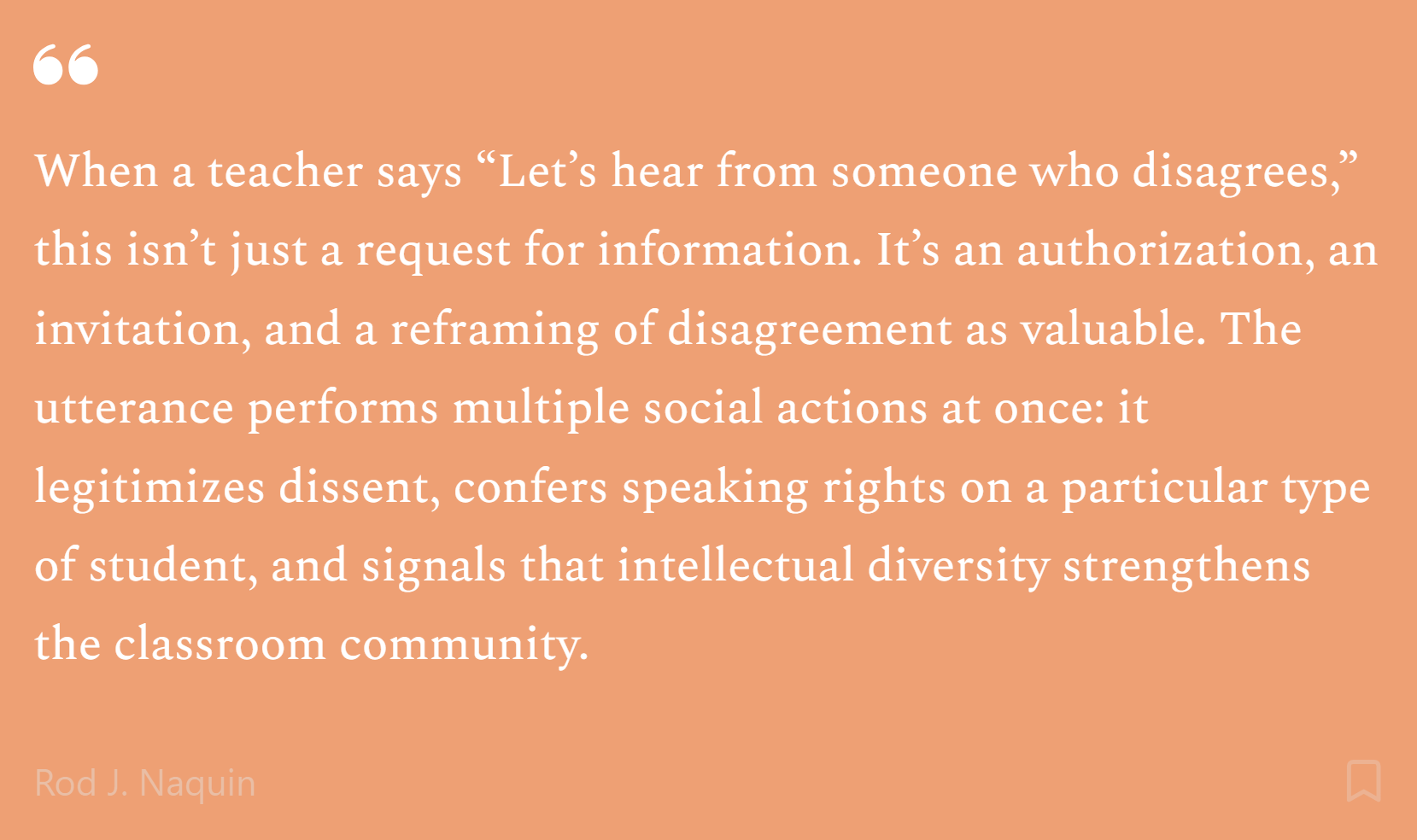
I recently posted the above quotation on LinkedIn from a thoughtful Substack piece by Rod J. Naquin about inviting disagreement into conversations.
Rod used the phrase:
Let’s hear from someone who disagrees.
I found myself instinctively changing it to:
Let’s hear from someone who sees this differently.
I much prefer that wording.
“Disagrees” can feel confrontational and binary. “Sees this differently” feels more exploratory. It invites another perspective without immediately creating sides.
Whether in the classroom or the workplace, small shifts in language like this can completely change the tone of a conversation.
We Are Built for Conversation
Why dialogue comes naturally to us rather than monologue
The paper Why is Conversation So Easy? by Simon Garrod and Martin Pickering argues that conversation only appears effortless. In reality, it involves extraordinary coordination. We speak in fragments, adapt constantly to context, interrupt at just the right moment, listen while planning what to say next, and somehow manage all this in real time, often with several people at once.
The paper suggests this works because dialogue is interactive. Through conversation, people gradually align their understanding with one another. Our brains evolved for this back-and-forth coordination, not for long one-way speeches.
Yet much of organizational and educational life still revolves around monologue. We admire great speakers and polished presentations, but our attention and understanding fade surprisingly quickly when communication becomes too one-sided.
We think, learn, and make sense of the world more effectively together, through interaction, questioning, clarification, disagreement, and response.
That does not mean abandoning presentations altogether. It means speaking less, inviting more participation, and recognizing that meaning is not simply delivered from one mind to another. It is created collaboratively.
We are conversational creatures. The most effective teams, organizations, and communities are likely to be the most conversational ones.
Saying More Than We Mean to Say
Why writing can sometimes reveal more than the writer knows
This was one of my recent quotes of the day - a well-known quotation from Dave Snowden.
We always know more than we can say, and we will always say more than we can write down.
One recipient responded with a simple but thought-provoking observation:
A few well-written words may say more than we know or say.
I think there is something profoundly true in that.
We often assume meaning sits neatly inside words, waiting to be transferred from one person to another. But meaning does not really work like that. It emerges through interpretation, through the relationship between the words and the reader.
The same sentence may leave one person untouched and stop another in their tracks. Not because the words changed, but because the reader brought different experiences, emotions, memories, and questions to them.
Sometimes writing reveals more than the writer consciously intended. A phrase can spark insights or connections the author never anticipated.
Perhaps that is why a few carefully chosen words can sometimes carry extraordinary depth. Not because the words themselves contain complete meaning, but because they invite the reader into the process of creating meaning for themselves.
Help Keep My Work Alive
Sustaining 25 Years of shared learning and conversation
For 26 years, I've been sharing the Gurteen Knowledge Letter each month, and many of you have been reading it for five years or more. My Knowledge Café also reached a milestone, celebrating its 20th anniversary in September 2022.
If my work has made a difference to you, I'd be grateful if you could consider supporting it. A small monthly donation or any one-off contribution would greatly help cover some of my website hosting costs.
Thank you to the 50+ patrons who have already supported me - your generosity means a great deal.
Coaching
Bringing Conversational Leadership into your daily practice
If you're curious about how a more conversational approach might shift the way you work with others, whether in leading, learning, or collaborating, I offer one-to-one coaching tailored to your context.
We explore real challenges and possibilities through dialogue, helping you develop your own way of practicing Conversational Leadership in daily work.
Unsubscribe
Unsubscribe to the Knowledge-Letter
If you no longer wish to receive this newsletter, please reply to this email with "no newsletter" in the subject line. I'll be sorry to see you go.
The Gurteen Knowledge Letter
A monthly reflection on Conversational Leadership and Knowledge Management
The Gurteen Knowledge Letter is a free monthly email newsletter, in its 25th year, designed to inspire thinking on Conversational Leadership and Knowledge Management. You can explore the archive of past issues and subscribe here.
Feel free to share, copy, or reprint any part of this newsletter with friends, colleagues, or clients, as long as it's not for resale or profit and includes proper attribution. If you have any questions, please contact me.
David Gurteen
Gurteen Knowledge
Fleet, United Kingdom