
|
|
Book
|
I am Right you are Wrong by Edward De BonoFrom This to the New Renaissance: From Rock Logic to Water Logic |

|
|
|
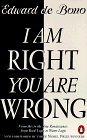 In this book Dr Edward de Bono puts forward a direct challenge to what he calls the rock logic of Western thinking. Rock logic is based on rigid categories, absolutes, argument and adversarial point scoring.
 He believes that this thinking is not creative and thus cannot help us solve our problems and create a better future. Instead of rock logic he proposes the water logic of perception. He believes this to be the key to more constructive thinking and the serious creativity of design. David Gurteen's comments: In my opinion one of de Bono's best books and there are a lot of them!
Blog Post  Changing our thinking methods Changing our thinking methodsGurteen Knowledge-Log, David Gurteen, 20 May 2002 Book  I am Right you are Wrong by Edward De Bono I am Right you are Wrong by Edward De BonoFrom This to the New Renaissance: From Rock Logic to Water Logic Opportunities (1978) by Edward De BonoA Handbook of Business Opportunity Search Six Thinking Hats (1985) by Edward De Bono The De Bono Code Book (Aug 2000) by Edward De BonoLink Edward deBono's WebEdward deBono's website Person  Edward De Bono (b. 1933) Psychologist & Author Edward De Bono (b. 1933) Psychologist & AuthorQuotation  On argument and truth by Edward De Bono (b. 1933) Psychologist & Author On humour and the human mind by Edward De Bono (b. 1933) Psychologist & Author On knowledge by Edward De Bono (b. 1933) Psychologist & Author On opportunities by Edward De Bono (b. 1933) Psychologist & Author On the purpose of science by Edward De Bono (b. 1933) Psychologist & Author On argument and truth by Edward De Bono (b. 1933) Psychologist & Author On humour and the human mind by Edward De Bono (b. 1933) Psychologist & Author On knowledge by Edward De Bono (b. 1933) Psychologist & Author On opportunities by Edward De Bono (b. 1933) Psychologist & Author On the purpose of science by Edward De Bono (b. 1933) Psychologist & AuthorQuotations from I am Right you are Wrong:  Argument is meant to reveal the truth, not to create it. Argument is meant to reveal the truth, not to create it.Edward De Bono, (b. 1933) Psychologist & Author Humour is by far the most significant behaviour of the human mind. You may find this surprising. If humour is so significant, why has it been so neglected by traditional philosophers, psychologists and information scientists? Why humour is so significant and why it has been so neglected by traditional thinkers together form the key to this book. Humour tells us more about how the brain works as mind, than does any other behaviour of the mind - including reason. It indicates that our traditional thinking methods, and our thinking about these methods, have been based on the wrong model of information system. It tells us something about perception which we have traditionally neglected in favour of logic. It tells us directly about the possibility of changes in perception. It shows us that these changes can be followed by instant changes in emotion - something that can never be achieved by logic. Edward De Bono, (b. 1933) Psychologist & Author If you are setting out to work in a new field you should thoroughly research that field. Right? Wrong! The traditional view is that you should read all that you can in order to get the base of existing knowledge and then move forward from this. There is a flaw in this argument and it is a flaw in the scientific method. We do not just get knowledge, we get knowledge packaged up as concepts and perceptions. ... Together these concepts and perceptions give what Thomas Kuhn called paradigms.Edward De Bono, (b. 1933) Psychologist & Author The purpose of science is not to analyse or describe but to make useful models of the world. A model is useful if it allows us to get use out of it.Edward De Bono, (b. 1933) Psychologist & Author
|
|
02:38 PM GDT |


/VIEW-IMAGE/$File/view-image.png "Media information")